NARGESA
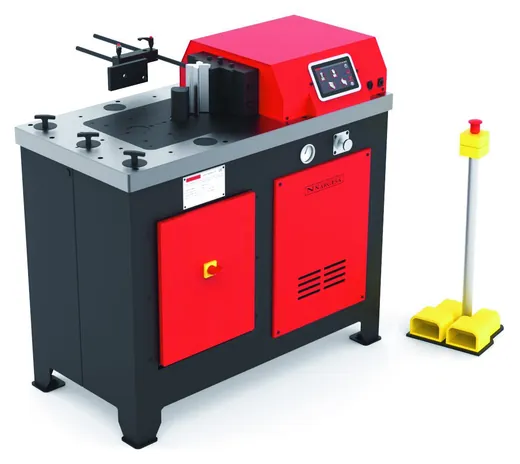
NARGESA PP200CNC
Country of manufacture: SpainForce: 20 tRam stroke: 250 mm
PRICE ON REQUESTDetails →
NARGESA PP200CNC horizontal bending press with ESA S625 CNC: 20 t, 250 mm stroke — bending and straightening bar, flat and angle.
A horizontal bending press bends rolled stock rather than sheet: round and square bar, flat bar, angle, small sections. The ram travels along the table, the part lies on it at working height, and the shape of the bend is set by interchangeable tooling — a punch and die for the specific operation. The same press is used to straighten parts. Such machines work in steel fabrication, forging and fitting shops, and in the production of fences, gates and brackets.
The catalog carries the NARGESA PP200CNC: 20 t force, 250 mm ram stroke, 9.8 mm/s working and 35 mm/s return speed, 950 mm working height, 665 kg. The ESA S625 CNC brings the ram to the set position with 0.05 mm repeatability: across a batch of identical parts the angle does not drift, and the program is stored for repeat orders.
For bending sheet — a box, a cover, a flange along the full length — you need a vertical CNC press brake. Arcs and rings from profile or tube are bent on a profile bending machine, while large sections and shafts are straightened on higher-force hydraulic presses. All bending machines are in the press brakes.
A press brake bends sheet along a long beam with tooling over the full bend length. A horizontal press has short tooling and a table the part lies on: it is for bar, flat, angle and small parts, and handles sheet only as narrow strips.
Yes, the manufacturer lists straightening alongside bending. A bent flat, bar or angle is placed on supports and pressed with the punch where needed; the CNC limits the stroke so the part is not bent the other way.
A drawing or photo of the part, the material and section, the bend angle or radius, and the number of parts per shift. From this we will choose the tooling and prepare a quotation with delivery and commissioning.
Send your part parameters — we'll select and quote.