LUNA
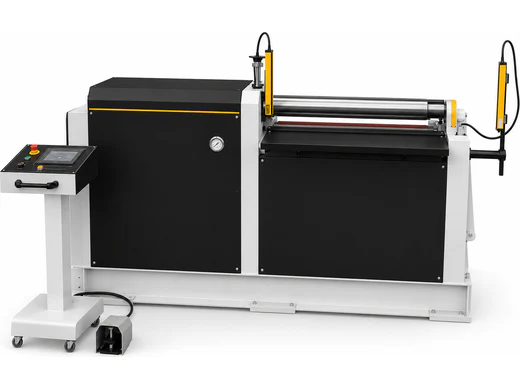
LUNA Nebula 2R 600/2
Number of rolls: 2Country of manufacture: ChinaControl: Hydraulic; automation optional
PRICE ON REQUESTDetails →
LUNA Nebula and MG plate rolls: two-, three- and four-roll machines, working width from 550 to 6100 mm, plate from 1.2 to 195 mm.
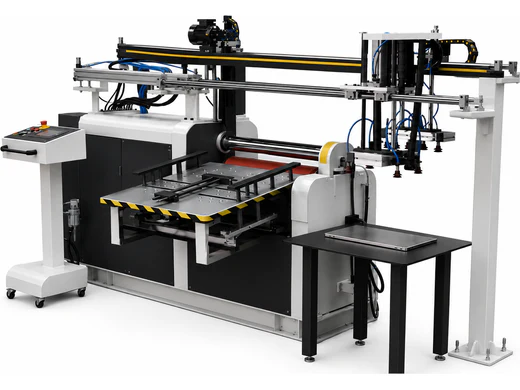
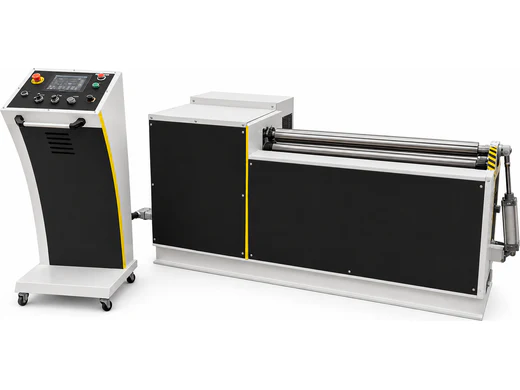
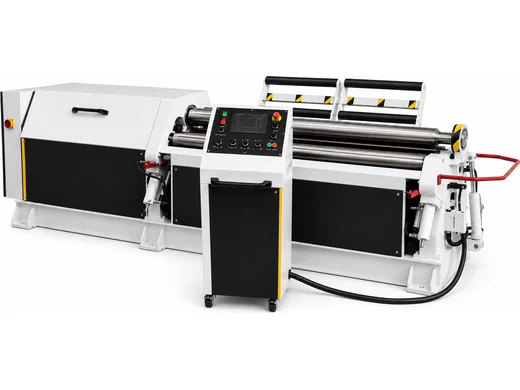
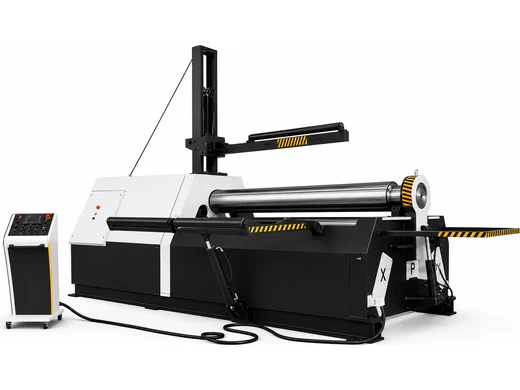
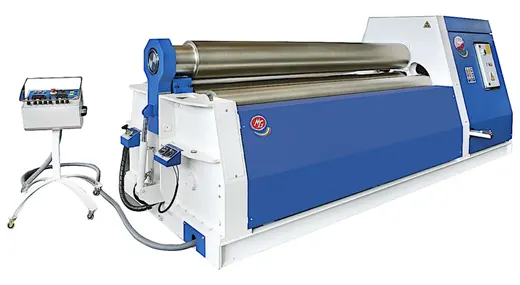
Plate rolls form sheet metal into shells, half-shells, arcs or cones: the plate passes between the rolls and every pass reduces the radius. This is how tank and silo bodies, large-diameter pipe, casings, cyclones and canopies are made. The catalog carries our own LUNA Nebula machines and Italian MG ones: working widths from 550 to 6100 mm, plate from 1.2 to 195 mm thick and drives from 1.1 to 380 kW.
| Type | How it works | Best for | In the catalog |
|---|---|---|---|
| Two-roll plate benders | the steel top roll presses the plate into the elastic polyurethane bottom roll, so the cylinder is formed in a single pass | thin plate and batches of identical cylinders | LUNA Nebula 2R and 2R-A: 600–2050 mm, up to 4 mm |
| Three-roll plate rolls | the top roll presses while two lower rolls drive the plate; the edges are pre-bent as a separate operation | general work, from a job shop to heavy engineering | MG G-GE-GL: 1250–3100 mm, up to 195 mm |
| Four-roll plate rolls | the plate is clamped between the central rolls and the radius is set by the side rolls, so both edges are pre-bent without re-setting | batch work, accuracy, less handling | LUNA Nebula 4R-S, 4R and 4R-H, MG M-ME-ML: 550–6100 mm, up to 160 mm |
Send the material grade, the plate thickness and width, the shell diameter you need and the number of parts — we will select the type, the model and the tooling and cost delivery, commissioning and training. If the part is bent to an angle rather than into a cylinder, see press brakes; for tube and profile there are profile bending machines; and the plate can be cut beforehand on laser machines or guillotine shears.
Two things are settled before the machine is even chosen: the blank length and what happens to the ends of the plate. The length is calculated from the neutral layer — π × (outside diameter − thickness) — otherwise the shell falls short by exactly πS. And the edges stay flat, because the plate is not gripped right from the edge, while the machine pre-bends at a smaller thickness than it rolls. Both calculations, with examples, are in the article on rolled shells and their development.
Two for batches of thin-walled cylinders: the shell is formed in one pass. Three is the universal choice for varied parts and thick plate, although the edges are pre-bent as a separate operation. Four when parts repeat and accuracy matters: the plate stays clamped and both edges are pre-bent without re-setting.
It is bending the straight end of the plate before rolling so that the shell has no flat section. The operation loads the rolls more heavily than rolling itself, so the permissible thickness for pre-bending is always lower than the maximum: 4 and 2.5 mm on the MG G-GE-GL 1204 L, for example.
The catalog has only hydraulic machines and programmable ones: manual rolls are made for thin sheet and do not give repeatability in batch work. The lightest models here are the MG M-ME-ML 0501 L for 1.5 mm plate 550 mm wide and the LUNA Nebula 4R-S for 1.2 mm.
The price depends on the width, thickness, number of rolls, control and tooling, and on delivery terms, so it is not listed on the site. Send a request and we will prepare a quotation including delivery, commissioning and training.
The material grade and yield strength, the plate thickness and width, the inside diameter of the shell, the length of the part, the monthly quantity and whether you need cones. From this we calculate the loads and select a model with its tooling.
Send your part parameters — we'll select and quote.