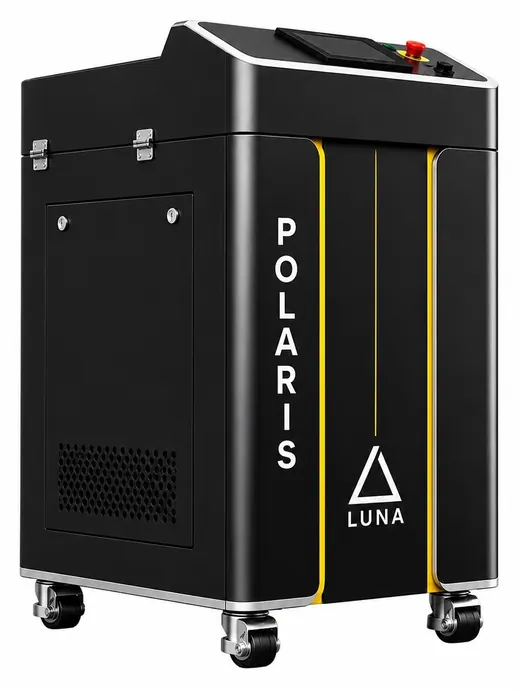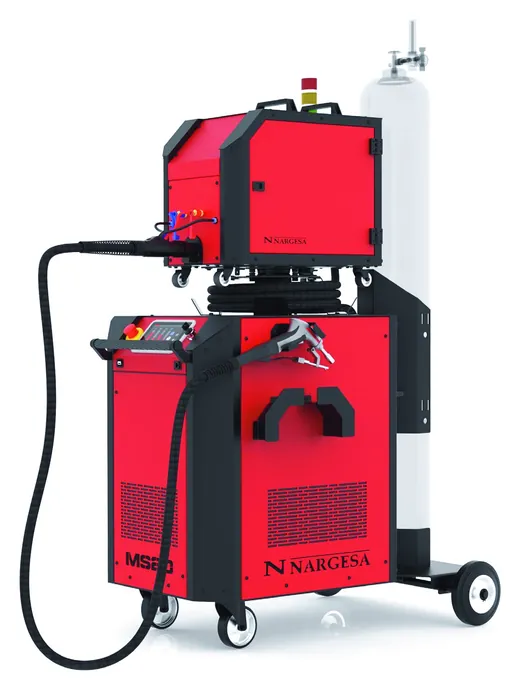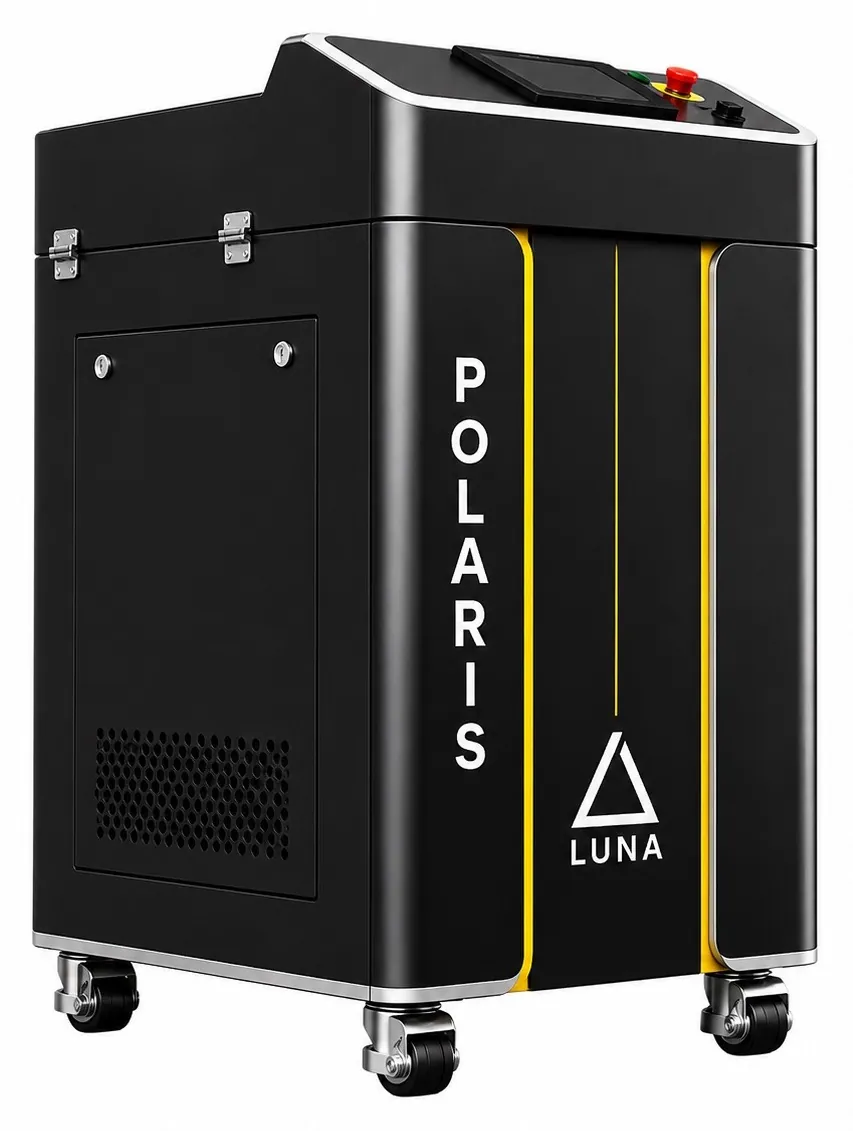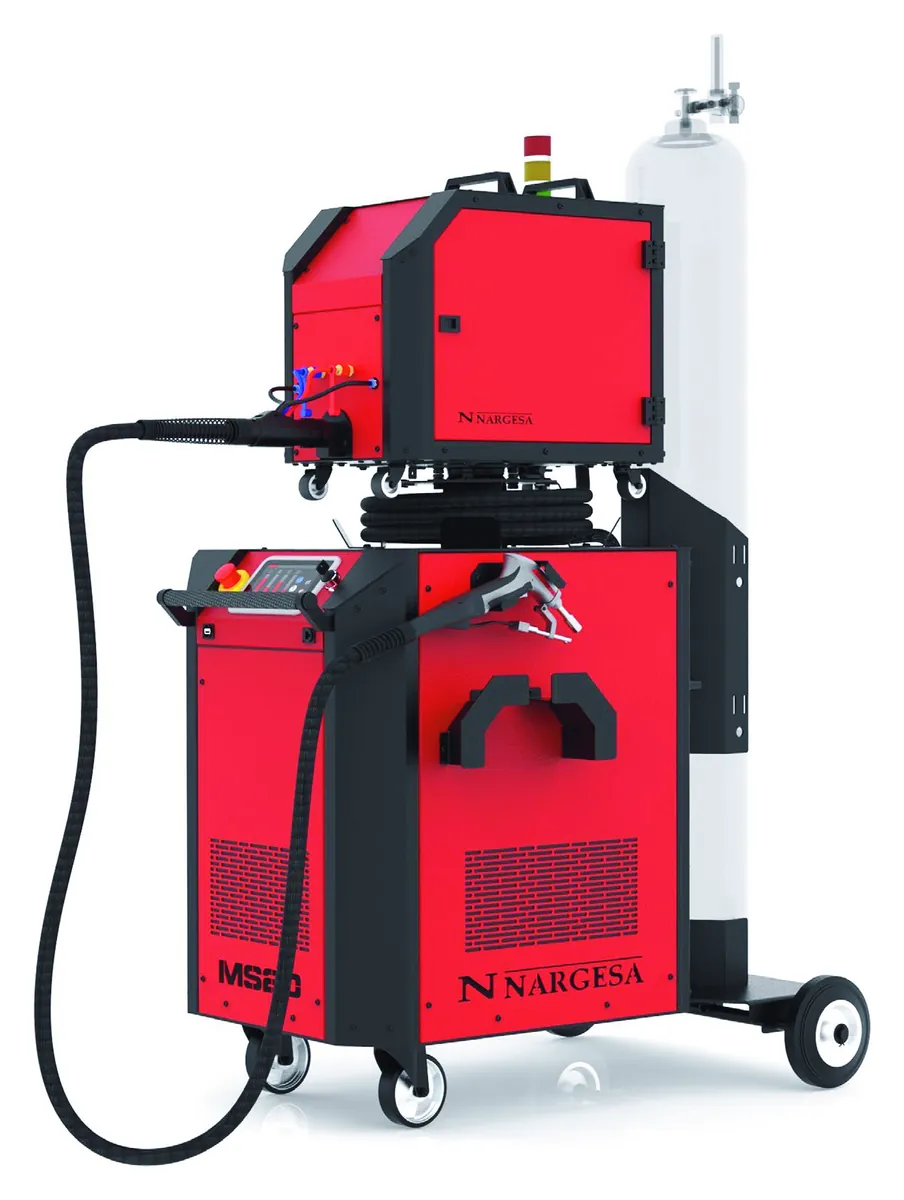
A handheld laser welder is a fiber source, a chiller and a light head on an optical fiber: the operator guides it along the joint like a torch, and the beam melts the edges in a narrow pool. The seam is narrow, the heat-affected zone is small and there is almost no spatter. The laser welding section has two such units: the LUNA POLARIS 4-in-1 at 1.5–6 kW and the NARGESA MS20 at 2 kW — both also clean metal and cut thin sheet.
Where the laser wins
- Thin sheet. A small heat-affected zone means less warping: panels, housings, cabinets and stainless products that would need straightening after MIG.
- Visible seams. The seam is narrow and even with almost no spatter, so post-weld cleanup is minimal — hours that do not go into grinding.
- Stainless steel and aluminium. Less overheating and heat tint next to the seam; aluminium needs more power, but the same unit welds it.
- One unit instead of several. The same source cleans the edges before welding and the oxides after it, cuts thin sheet on site and feeds filler wire.
Where MIG stays
- Inaccurate fit-up. A laser does not like gaps. According to TWI, the UK welding institute, without filler the gap in a butt joint should be under 10% of the thickness: 0.1 mm on 1 mm sheet, 0.3 mm on 3 mm. Wire feed widens the tolerance to roughly the sheet thickness for steel up to 6 mm, but speed drops. MIG forgives much larger gaps.
- Thick metal. The guide for POLARIS is up to 4.5 mm at 1.5 kW, up to 10 mm at 3 kW and up to 16 mm at 6 kW; the NARGESA MS20 penetrates up to 6 mm in steel and 5 mm in aluminium. Heavy steel structures from thick sections remain MIG work.
- Dirty metal and outdoor work. A laser needs clean edges: rust and paint are removed before welding — with the same unit. And welding on an open site with a class 4 laser is a safety task of its own.
Laser, MIG and TIG
| What we compare | Handheld laser | MIG/MAG | TIG |
|---|---|---|---|
| Thin sheet | little warping, narrow seam | warping and spatter | neat but slow |
| Thick metal | 4.5–16 mm depending on power | the main job | slow, many passes |
| Joint gap | up to 10% of thickness without wire | forgives large gaps | forgiving: the welder adds filler |
| Cleanup afterwards | minimal | spatter and bead to grind | minimal |
| Safety | class 4 laser: eyewear, enclosed area, extraction | helmet and extraction | helmet and extraction |
Power: 1.5, 2, 3 or 6 kW
Choose the power for the thickest metal you will weld regularly, not for a record: on thin sheet you simply turn it down in the settings. The guide figures above are for steel; aluminium, copper and brass reflect the beam more and need more power. The NARGESA MS20 runs on a 220–240 V single-phase supply, the POLARIS on 220 or 380 V depending on the configuration. The shielding gas is nitrogen or argon, cooling is by water and the chiller is included.
Safety and space in the shop
A handheld welding laser is a class 4 laser: not only the direct beam but also a reflected one is dangerous. You need eyewear rated for the fiber laser wavelength (NARGESA supplies the MS20 with glasses for the 900–1100 nm band), an enclosed area or curtains so the beam cannot reach neighbouring workstations, and fume extraction — especially on galvanised steel. That is no reason to give up on the laser, but it is a budget line and part of the area layout.
What to check before buying
- Your own sample. Bring your parts with their real fit-up and look at the seam, penetration and time. Everything else is an estimate.
- How the parts are fitted. If the gaps vary, plan for wire feed or improve the fit-up — otherwise the laser will not deliver the promised quality.
- Materials. Steel, stainless steel, aluminium, brass, copper — the settings differ, so list everything you will weld.
- Power and gas. 220 or 380 V, nitrogen or argon, room for the cylinder and the chiller.
- Work area. Budget for the enclosure, eyewear and extraction together with the unit.
- What else the unit will do. Cleaning and thin-sheet cutting come in the same machine — compare the price with how many separate operations it replaces. What laser cleaning actually removes is covered in the article on laser cleaning of metal.