A press brake is bought for years, and a wrong choice shows up in the first batch: not enough force for thicker sheet, the part does not fit between the side frames, the angle drifts along the length. Below is the order in which LUNA engineers check a press brake against a job. Start with the parts you bend now and the ones that will come in the next few years.
Bending force: how many tonnes you need
Force depends on the material, sheet thickness, bend length and V-die opening. For air bending it is estimated with the same formula our bending calculator:
Example: steel with σ = 450 N/mm², 3 mm sheet, 1 m bend length, V24 die — about 24.4 t. A 20–30 % reserve is added to the result: the actual strength of a batch of metal can be higher than the nominal value, and tooling wears. So this part needs a press of at least 30–35 t.
The die opening is usually about 8 sheet thicknesses up to 3 mm, 10 thicknesses up to 8 mm and 12 for thicker sheet. A wider die needs less force but gives a larger inside radius and a longer minimum flange — roughly 0.7 of the die opening: about 18 mm on a V25 die. The table below uses the same rules, per 1 metre of bend length:
| Thickness S, mm | Die V, mm | Inside radius, mm | Steel σ 450, t/m | S355 steel σ 560, t/m | Stainless σ 700, t/m |
|---|---|---|---|---|---|
| 1 | 8 | ≈ 1,3 | 8,1 | 10,1 | 12,7 |
| 1,5 | 12 | ≈ 1,9 | 12,2 | 15,2 | 19,0 |
| 2 | 16 | ≈ 2,5 | 16,3 | 20,3 | 25,3 |
| 3 | 25 | ≈ 3,9 | 23,4 | 29,2 | 36,5 |
| 4 | 40 | ≈ 6,3 | 26,1 | 32,4 | 40,5 |
| 5 | 50 | ≈ 7,8 | 32,6 | 40,5 | 50,7 |
| 6 | 63 | ≈ 9,8 | 37,2 | 46,3 | 57,9 |
| 8 | 80 | ≈ 12,5 | 52,1 | 64,8 | 81,1 |
| 10 | 125 | ≈ 19,5 | 52,1 | 64,8 | 81,1 |
| 12 | 160 | ≈ 25,0 | 58,6 | 73,0 | 91,2 |
At 10 mm the force per metre is no higher than at 8 mm, because thick sheet is bent on a wider die. To get the force for the whole part, multiply the table value by the bend length in metres: 6 mm steel sheet 3 m long needs about 112 t, and with a reserve from 140 t.
CalculatorCalculate the bending force for your sheetMaterial, thickness, bend length and V-die — the tonnage and suitable press brakes in a minute.Bend length and distance between side frames
The nominal length of a press — for example 3100 or 3200 mm — is the longest sheet it will bend. Full force is meant for a long bend: a short, thick part concentrates the load on a small section of the beam and tooling. For such parts check the permissible load per metre, both for the press and for the punch and die.
The distance between the side frames shows which part with flanges can be passed between the uprights to bend one more flange. For boxes and trays this often matters more than the nominal length. For LUNA Taurus it is listed in the specifications of every model.
Throat depth, ram stroke and open height
- Throat depth is how far past the bend line the sheet can enter the side frame. It is needed when the bend is longer than the distance between the side frames and the edge of the sheet passes through the throat.
- Ram stroke and open height decide whether a deep box is possible: the tooling and the flanges already bent have to fit between the beam and the table. For tall flanges choose a press with more open height and tall tooling.
Back gauge axes
The back gauge sets where the bend line runs, and the number of controlled axes sets how much manual work is left to the operator.
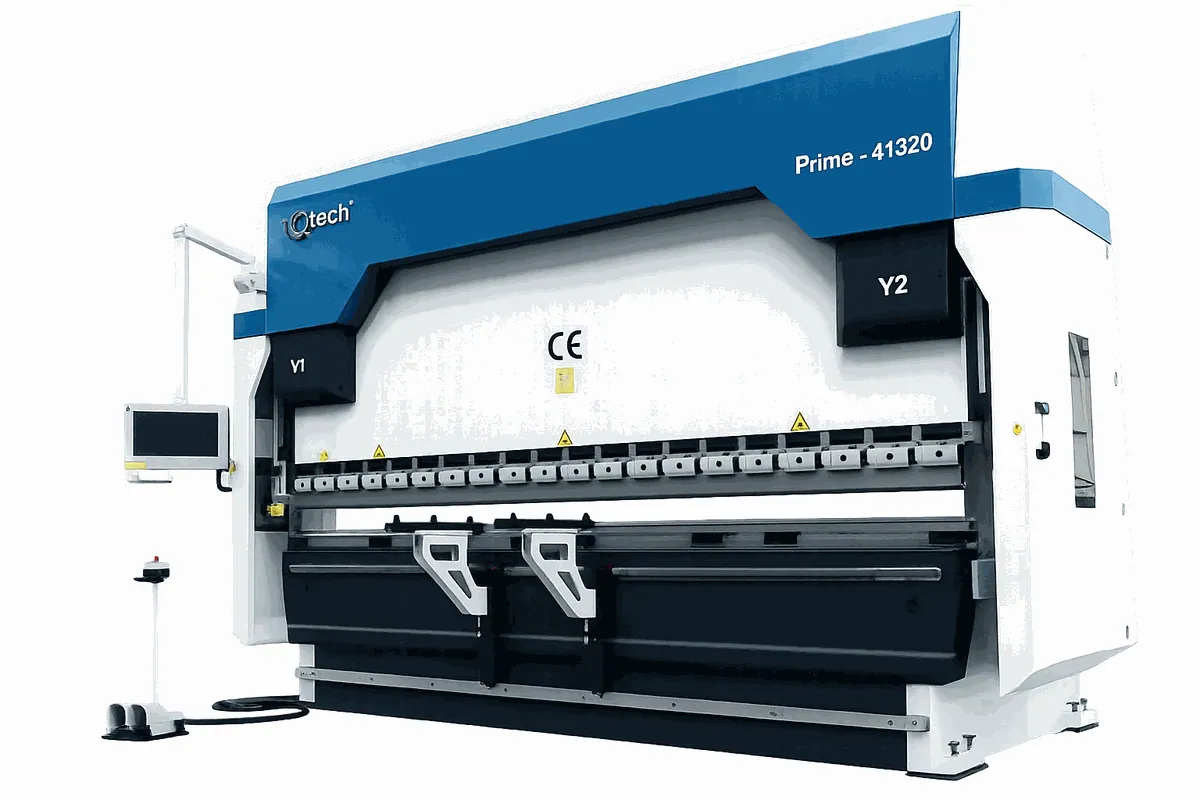
- Y1/Y2 are two independently controlled ram cylinders: they keep the beam parallel to the table and allow slight taper bends.
- X moves the gauge forward and back, which is the flange size.
- R raises the gauge: for parts with a flange that is already bent.
- Z1/Z2 move the gauge fingers along the beam: different flanges in one program without resetting by hand.
The LUNA Taurus series is available with 3, 4, 6 and 8 axes — from Y1+Y2+X to Y1+Y2+X1+X2+R1+R2+Z1+Z2. TRtech Fortis has 4 axes, 2 of them on the back gauge, and TRtech Prime has 6 axes, 4 of them on the back gauge. For angles and simple flanges X is enough; for enclosure parts with several bends of different heights R and Z pay off.
Controller
The controller sets the bend sequence, the angle and the gauge position. For LUNA Taurus it is chosen for the job: Cybelec CybTouch 8, 12 or 15 PS, ESA VIS-840 or VIS-875, Delem DA-53TX, DA-58TX, DA-66S or DA-69S. TRtech Fortis comes with Cybelec Touch 8. A simple controller is enough for bending to a drawing one bend at a time. Graphical programming with simulation is needed for complex parts and frequent changeovers: before the first bend the operator sees whether the part will hit the tooling or the frame.
Crowning
Under load the table and the beam deflect, so in the middle of a long part the angle comes out more open than at the ends. Crowning evens out the angle along the length. It can be mechanical or hydraulic: TRtech Fortis has motorised hydraulic crowning, TRtech Prime dynamic hydraulic crowning. For parts longer than 2 m and thick sheet it is hard to hold the same angle without it.
Tooling
Budget for punches and dies right away, together with the press. Check the tool clamping system, for example European Promecam style or New Standard: it decides which tooling you can add later. Boxes need a sectional punch that is assembled to the required length.
Safety
Check what is included: laser protection of the area under the punch or light curtains, side and rear guards, and a foot pedal with an emergency stop. Protection affects not only operator safety but also speed: with laser protection the beam can approach the sheet quickly.
TRtech or LUNA Taurus
The LUNA catalog carries Turkish TRtech press brakes and the Chinese LUNA Taurus series:
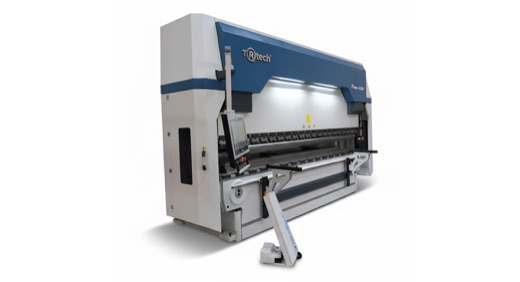
- TRtech Fortis — 60–400 t, bend length 1250–6100 mm, 4 axes, motorised hydraulic crowning, Cybelec Touch 8 controller.
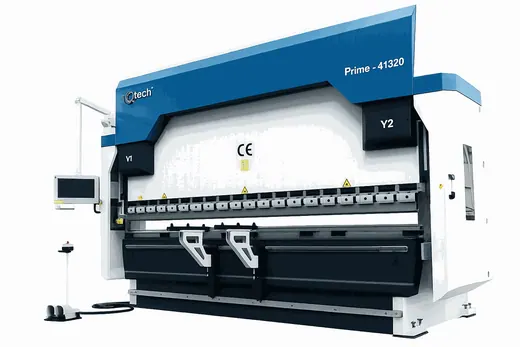
- TRtech Prime — 60–1600 t, length 2100–10 100 mm, 6 axes and dynamic hydraulic crowning: for heavy and long bending.
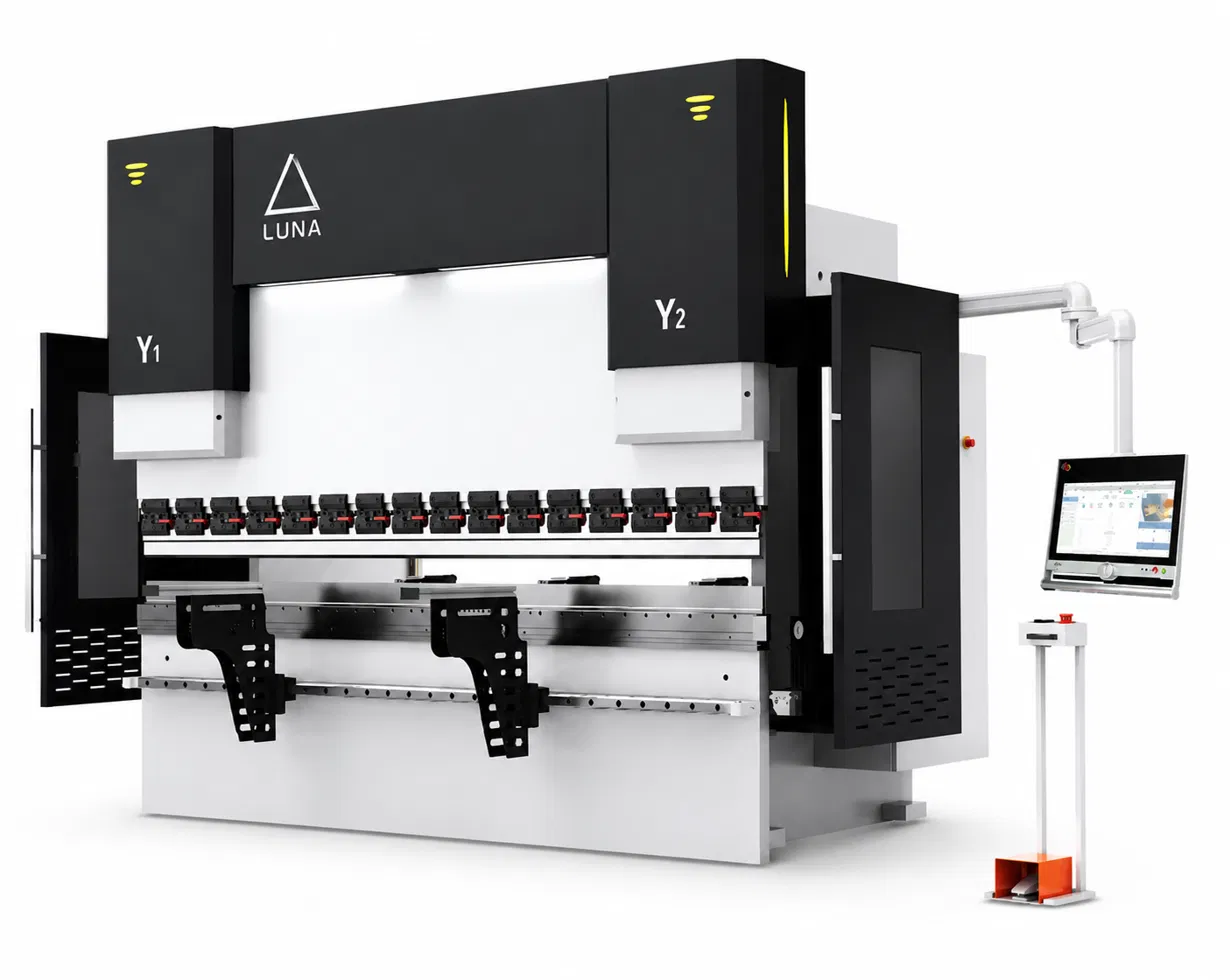
- LUNA Taurus — 40–300 t, 1250–4000 mm, 3 to 8 axes and a choice of Cybelec, ESA or Delem controllers: the configuration is built for the job and the budget.
You can compare models in the press brakes section: every page lists the force, length, axes and controller.
After the purchase: start-up and training
The press is placed on a level concrete floor, and heavy models on a foundation to the manufacturer’s drawing. During commissioning the power is connected, the hydraulic oil is filled, and the beam parallelism and the safety system are checked. Then the operator is trained on the controller and tooling using your parts. Ask the supplier what the start-up includes and how many days the training takes.
Common mistakes
- Buying a press with no tonnage reserve instead of 20–30 %.
- Calculating force for mild steel and then bending stainless: it needs about one and a half times more force.
- Forgetting the parts that will come in a year or two: thicker sheet or a longer product.
- Buying the press with no budget for tooling and safety equipment.
- Saving on back gauge axes with a wide range of parts: every manual gauge reset costs operator time and risks scrap.
What to prepare before a request
- Drawings of the two or three most complex parts.
- The material and grade, and the thickness range.
- The longest bend and the blank size.
- The flange height and box depth, if any.
- The number of parts per shift and how often the part range changes.
- The required angle accuracy.
With this data an engineer will calculate the force, select the length, axes and tooling, and propose several configurations for different budgets.
Equipment from the catalog
Questions and answers
How many tonnes do I need to bend 3 mm sheet?
For steel with σ 450 N/mm² on a V24 die — about 24 t per metre of bend length, and about 30 t with a 25 % reserve. For a longer part multiply by its length in metres, for stainless allow about one and a half times more. The bending calculator.
How many back gauge axes do I need?
For angles and simple flanges the X axis is enough. Parts with several bends of different heights need the R axis, and different flanges in one program need Z1/Z2.
Which matters more — tonnage or length?
Tonnage decides whether the press can bend your thickest sheet, and length whether your longest part fits. Calculate tonnage for the thickest sheet at its actual bend length.
Do I need crowning?
For short parts in thin sheet you can do without it. For parts longer than 2 m and thick sheet, without crowning the angle in the middle comes out more open than at the ends.