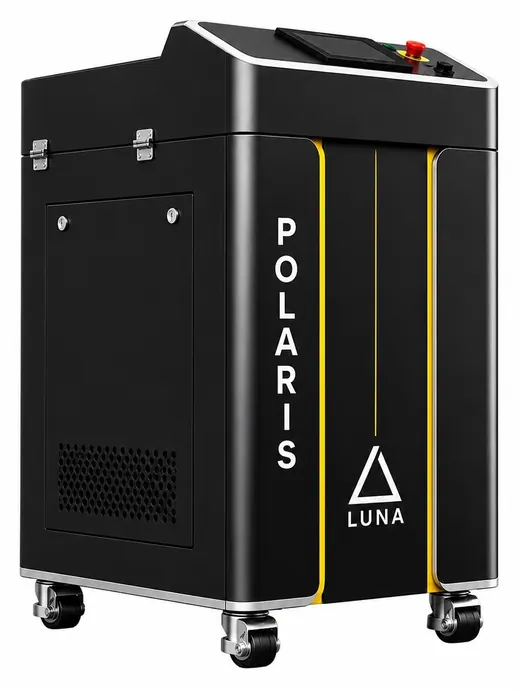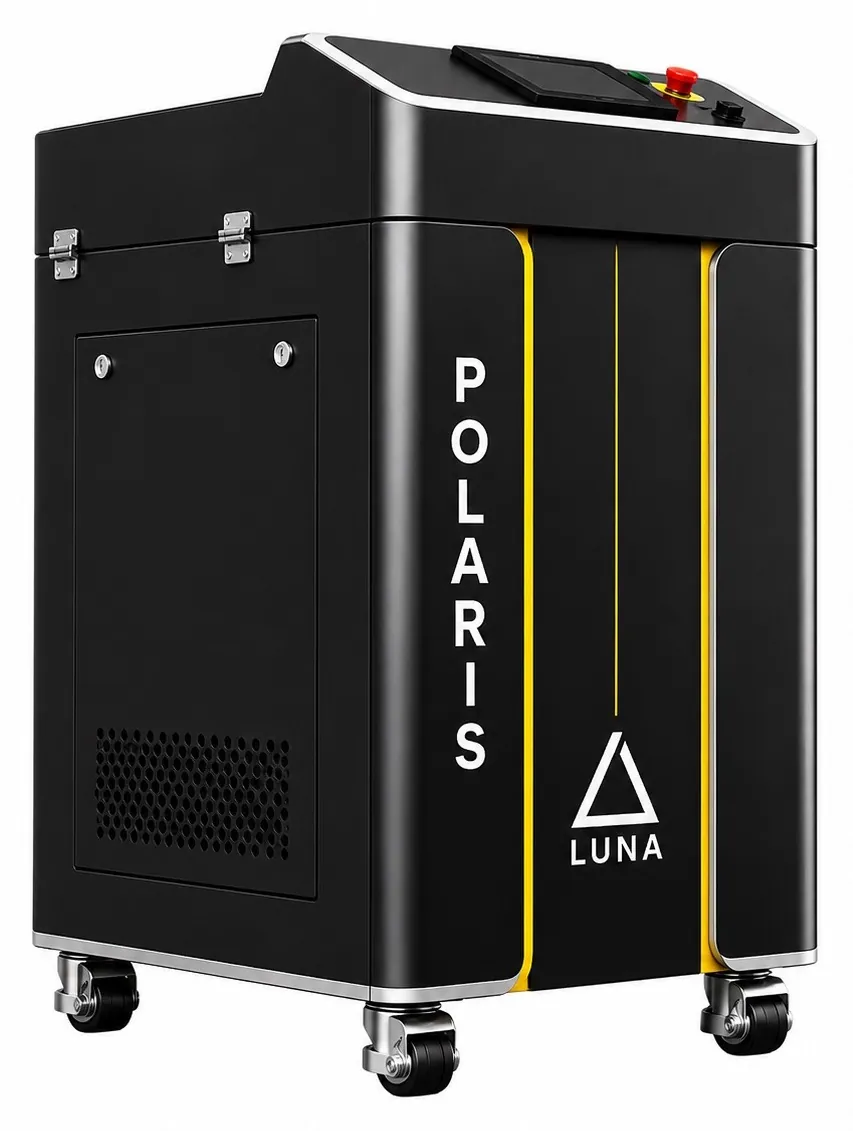
Laser cleaning removes the surface layer with a beam: contamination and oxides absorb the radiation far more strongly than the clean metal underneath, so the layer evaporates and the base survives. No abrasive, no chemicals, no immersion — only electricity, assist gas and extraction. In the catalog this is done by the LUNA POLARIS 4-in-1: one machine with four functions — welding, cleaning, thin-sheet cutting and wire feed.
What the laser removes and what it does not
- Rust and scale. The main job: corrosion products and mill or heat-treatment scale come off and the metal is left clean.
- Old paint and primer. They come off, but a multi-layer coating will not go in a single pass; the thickness of the layer drives the time directly.
- Grease, carbon deposits, adhesive residue and markings. The things you would otherwise wash off with solvent.
- Post-weld oxides. Discolouration beside the seam is removed locally, without a wire brush and without taking base metal with it.
What not to expect from a laser is large continuous areas per shift: on a frame or a steel structure abrasive blasting will be faster. Nor one setting for everything: parameters are chosen for the material, the type of contamination and the thickness of the layer.
Why "no abrasive" is not a detail
Blasting removes the layer mechanically, and the abrasive has to be bought, stored, sieved and disposed of, while dust settles in the cabinet and on the part. A laser has no consumables: electricity, assist gas and a filter in the extraction. But the difference is not only in logistics.
- Part geometry. Abrasive takes a little of the base metal along with the rust, so size and roughness change. A laser works on the surface layer — for critical parts the setting is still selected and proven on a sample.
- The part after cleaning. Abrasive leaves a rough surface, and for painting that is often a plus: roughness holds the primer. After a laser the surface is smoother, so the paint system is worth agreeing in advance.
- Floor space. A blast cabinet is an enclosure of a fixed size, and the part has to be brought to it. A laser stays put and the head goes to the part.
Power: 1.5, 2, 3 or 6 kW
The POLARIS comes with four source options — 1.5, 2, 3 and 6 kW, MAX or Raycus. More power means faster cleaning but also more heat into the part: on thin sheet the excess turns into distortion, so power is chosen for the thinnest part rather than the thickest. Cooling is by water with the chiller included; the supply is 220 or 380 V depending on configuration; the assist gas is nitrogen or argon.
The SUP23T head weighs 0.7–1.3 kg and hangs on a 10 m fibre (15 m optional) or a 20 m one. That is the main practical difference from a cabinet: the machine stays where it is and the operator walks to the part — a frame, a machine bed or an assembly that must not be taken apart.
Laser or blasting — which when
The catalog holds both, so the comparison is an honest one. The main difference is not the quality of cleaning but where the part has to travel.
| What we compare | Laser cleaning | Blast cabinet |
|---|---|---|
| Part size | any: the head on a 10–20 m fibre goes to the part | only what fits the chamber: 1000×680 or 1300×880 mm, up to 100 kg |
| Consumables | none — electricity, gas, filter | abrasive: purchase, sieving, disposal |
| Surface after cleaning | smoother, the paint system is agreed separately | rough — an anchor for primer |
| Large continuous area | slower | faster |
| Complex shapes and blind corners | needs a straight line of sight — the beam does not turn | abrasive reaches where the beam cannot |
| Dust and cleaning up | extraction with a filter | dust in the cabinet, cleaning and abrasive changes |
So blasting wins where a lot has to be cleaned roughly: a frame, a structure, a batch of identical parts before painting. The laser wins where the part will not go into a cabinet, where dust and abrasive must not get into assemblies, and where the layer has to come off locally — a weld seam, a mould, an area next to a thread. The cabinets are in the dry blasting and wet blasting.
What to check before buying
- Your own sample. The most reliable test is to bring your part with your contamination and watch the rate and the result. Everything else is an estimate.
- Extraction and filter. The evaporation products have to be drawn off and filtered. That is a separate piece of equipment, and it is often left out of the budget.
- Supply and cooling. 220 or 380 V depending on configuration; the chiller is included, but it needs space and access for service.
- Fibre length. 10, 15 or 20 metres — it decides how far from the machine the operator can work without moving it.
- Safety. Eye protection and a defined working area are required: a reflected beam is as dangerous as a direct one.
- What else the machine will do. The POLARIS combines cleaning with welding, thin-sheet cutting and wire feed. If only cleaning is needed, the configuration is agreed separately — the other functions are not free in the price.