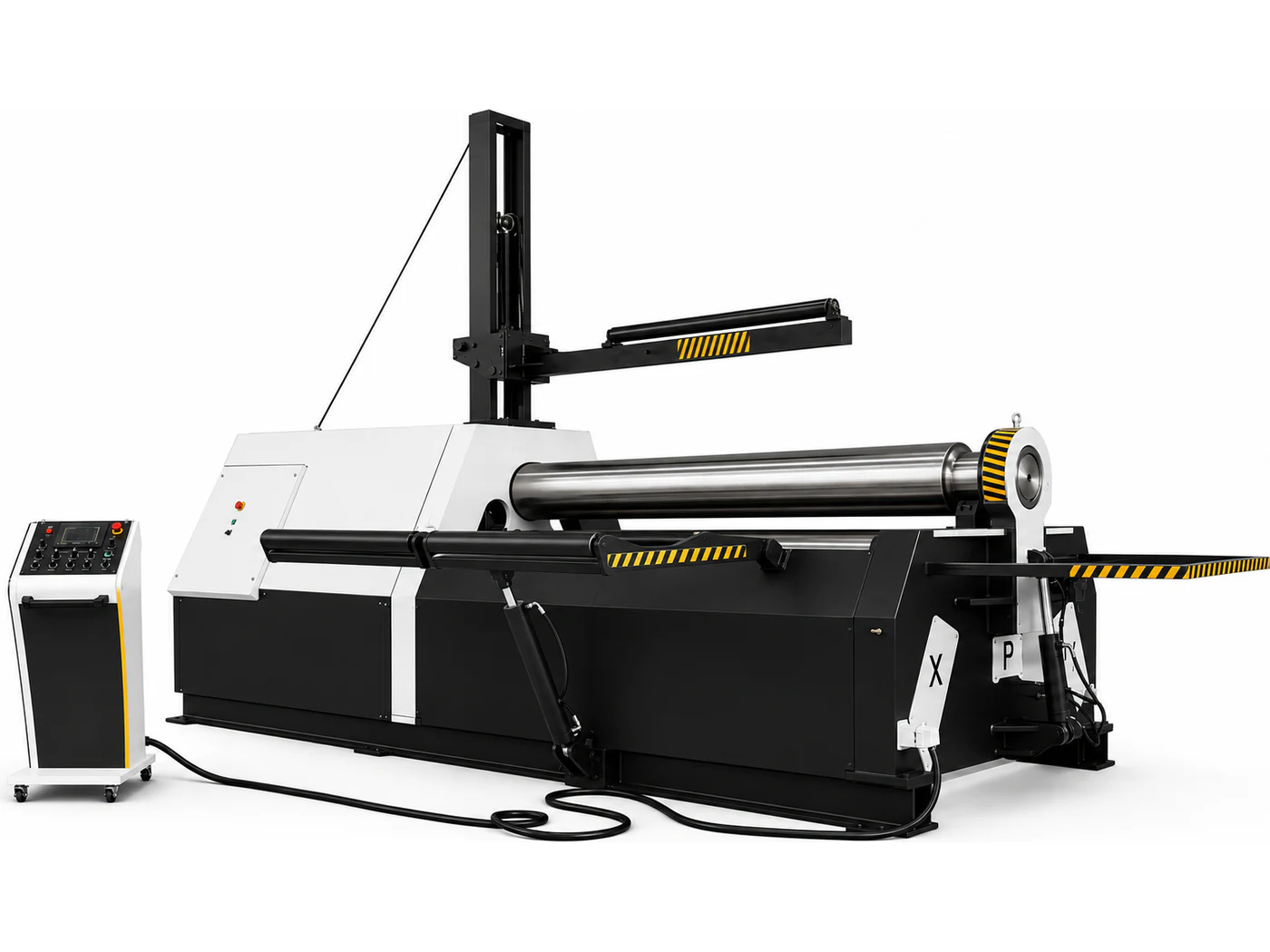
A shell is the cylindrical part of a body, rolled from plate and welded along the seam: tanks, silos, hoppers, chimneys, drums, cyclone and filter bodies are all built from them. In Ukrainian it is called an obychaika, in Russian an obechaika, and drawings sometimes call it a course. The part looks simple, but it is got wrong in two places: the length of the blank, and what happens to the ends of the plate.
Blank length: measure the neutral layer
When plate is rolled, the outer fibres stretch, the inner ones compress, and somewhere between them lies a layer whose length does not change. That layer sets the length of the blank. For plate rolled into a cylinder the neutral layer runs roughly through the middle of the thickness, so:
An example: a shell of 1000 mm outside diameter from 8 mm plate. L = 3.1416 × (1000 − 8) = 3116 mm. Take the outside diameter without the correction and the blank comes out 25 mm too long — exactly πS — and the edges have to be trimmed after rolling.
- The thicker the plate, the less "the middle" holds. On heavy plate the neutral layer shifts towards the inner surface and the factor drops below 0.5. For critical work it is refined on a trial part rather than taken from a handbook.
- The seam has a length too. A butt joint with no gap needs no allowance, but if the seam runs with a gap or the edges are prepared, that is a separate allowance set by the welding procedure.
- A conical shell is calculated differently. There the development is not a rectangle but a ring sector, and on the rolls it is made with the rolls skewed. That is a different job from a cylinder.
Why the ends stay flat
The plate is not gripped right from the edge: the strip from the edge to the point where bending starts stays straight. On the finished shell it shows as flat patches on both sides of the seam — the part is "not round" exactly where it is welded. So the edges are pre-bent separately: either on a press before rolling, or on the rolls themselves if the machine can do it.
| Rolls | What happens to the ends | What they are bought for |
|---|---|---|
| Two-roll | the plate is pressed against a polyurethane roll along its whole length and the shell comes out in one pass | thin plate, batches of identical shells |
| Three-roll | the ends are pre-bent as a separate operation or by repositioning the plate | general work, varying diameters and one-off parts |
| Four-roll | both ends are pre-bent on the machine itself, the plate is not repositioned | series work, heavy plate, when cycle time matters |
Pre-bending thickness is not rolling thickness
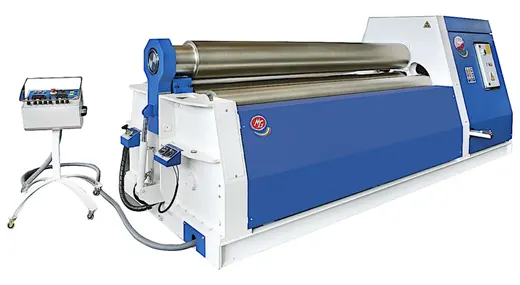
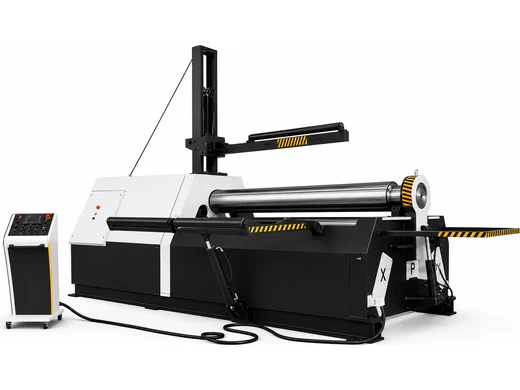
This is where the choice of machine goes wrong most often. Rolls pre-bend an edge thinner than the plate they can roll, and the data sheet gives these as two different numbers. The MG G-GE-GL 1204 L takes 4 mm maximum but pre-bends 2.5 mm. The MG G-GE-GL 1706 L takes 6 and 4 mm. The heavy LUNA Nebula 4R-H 4100/20 rolls 20 mm and pre-bends 16 mm.
So if your shell is made from 6 mm plate, a "6 mm" machine will roll it but will not pre-bend the edge — and the flat patches will have to be dealt with some other way. Check both numbers.
Springback and the first part
Once the force is released the metal partly straightens: the diameter comes out larger than the one the rolls were set to. How much depends on the yield strength of the particular batch of plate rather than on the grade in the certificate, so the first part is made with a check — roll it, measure it, adjust. Steel with a higher yield strength springs back more, and on thin plate it shows more than on heavy plate.
The seam is best welded before the shell leaves the machine, or at least with a strap fitted: an unwelded shell opens up.
What to state to have a shell quoted
- The diameter — and which one. Outside, inside or mean: the blank length depends on it.
- Thickness, width and steel grade. Yield strength drives both the force and the springback; stainless and high-strength steels need more margin than ordinary structural steel.
- The length of the shell — that is the working width of the rolls, and it has to leave a margin to the edges.
- Whether the edges need pre-bending — and at what thickness.
- How many. One shell and a series are different machines: three-roll machines are enough for one-offs, while four-roll ones pay for themselves on cycle time in series.
The plate rolls.
Equipment from the catalog